Strong In Body And Mind



You’re already encouraging your clients to make strength training a regular part of their exercise routine, since a loss of strength as a person ages can threaten both their independence and their wellbeing. Yet beyond being able to physically do the things they love, there’s a new reason to encourage older clients to find a strength training solution that works for them. Recent evidence suggests that strength training combined with an active lifestyle can not only keep the body strong, but also protect the brain and thinking abilities.
The Dangers of Dementia
It is no surprise that worries about dementia loom large among older clients. Dementia is a progressive brain disease that involves severe social and thinking impairments. This widespread disease affects more than 55 million individuals worldwide, with nearly 40% of 50- to 64-year-olds having a family member with dementia. It has an enormous impact on the individual and their loved ones, and though dementia has no cure, physical activity is the top modifiable risk factor.
Fighting Dementia with Strength
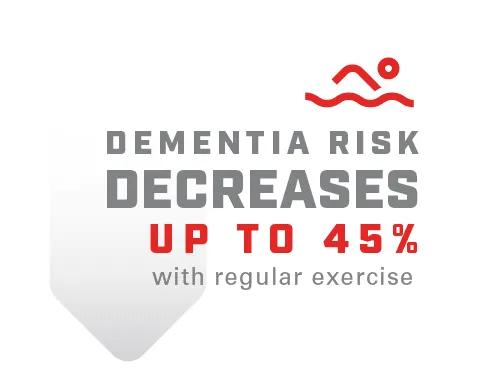
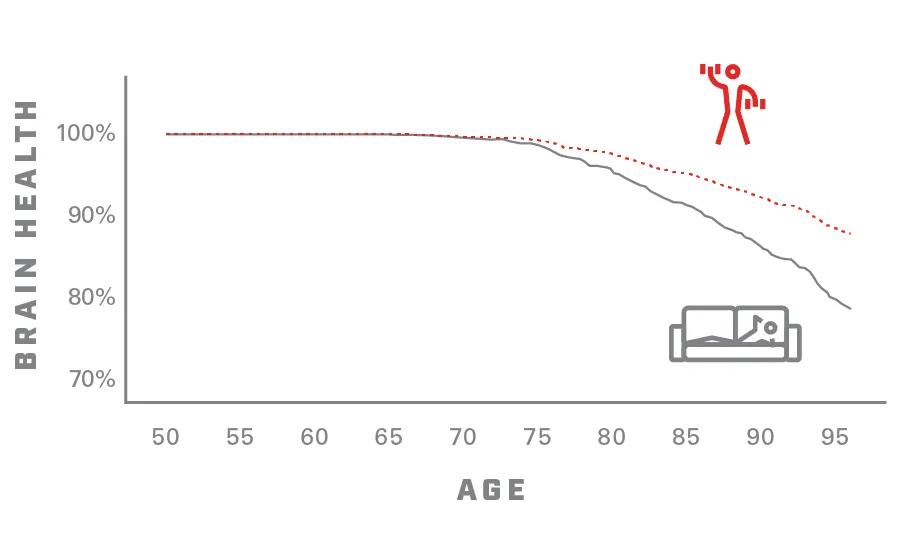
In advanced age, brains tend to change in ways that limit their function. However, individuals who remain strong and active do not show the same changes as those who are inactive. In addition to having brains that avoid age-related structural changes, stronger individuals fare better in cognitive testing. On average, stronger individuals have a greater ability to reason, remember and problem-solve well into advanced age. In fact, regular exercise can lower dementia risk by 30% to 45%, depending on the type of dementia. A growing mountain of evidence shows that strength tests are a good indicator of thinking abilities, so retaining muscle mass is all the more important for aging clients.
“The message is clear,” explained dementia expert Dr. Michael Valenzuela. “Resistance exercise needs to become a standard part of dementia risk-reduction strategies.”
Strength Predicts Brain Health
Many studies support the link between strength and brain health. For example, one study monitored over 1,000 older adults for 15 years, documenting their lifestyles and medical histories while testing their strength along the way. The results determined that lower strength was a significant risk factor for developing dementia, independent of genetic risk and lifestyle factors such as smoking and alcohol use. Those who had the largest decline in strength were in fact, twice as likely to develop dementia compared to those who had maintained their strength throughout the 15-year study.
Learning to be Strong
So, why is strength so important to the brain health of your aging clients? It may be because muscle strength is a skill gained through repeated physical challenges. The brain coordinates the majority of muscle contractions, so every workout is a chance to fine-tune motor skills. In fact, recent evidence shows that this strength-cognition advantage is more than simply correlation. Brain scans and cognitive testing can be done before and after exercise interventions to determine how regular workouts influence the structure and function of the brain. In older adults, these studies show that several months of regular exercise actually enlarges brain regions associated with memory, a result backed up by cognitive testing. More and more medical and therapeutic experts are embracing the fact that strength training actually causes positive brain changes.
Bolstering Brain Health, One Rep at a Time
Studies indicate that older individuals enjoy significant brain benefits from strength training, even if they only participate in one sessions per week. Additional evidence suggests that for the best outcomes and measurable improvements to brain structure, two or more strength training sessions per week are ideal. For all the older adults you work with, be sure to encourage them to view strength training as a way to build not only a stronger body, but also a healthier brain.

Karlie Intlekofer, PhD, CNC, CPT
References
Best et al. Long-term effects of resistance exercise training on cognition and brain volume in older women: Results from a randomized controlled trial. Journal of the International Neuropsychological Society 2015; 21(10): 745-56. https://doi.org/10.1017/S1355617715000673
Broadhouse et al. Hippocampal plasticity underpins long-term cognitive gains from resistance exercise in mild cognitive impairment. NeuroImage: Clinical 2020; 25; 102182. https://doi.org/10.1016/j.nicl.2020.102182
Erickson et al. Exercise training increases size of hippocampus and improves memory. PNAS 2011; 108(7): 3017-22. https://doi.org/10.1073/pnas.1015950108
Hamer & Chida. Physical activity and risk of neurodegenerative disease: a systematic review of prospective evidence. Psychological Medicine 2009; 39(1): 3-11. https://doi.org/10.1017/S0033291708003681
Maust et al. Perception of dementia risk and preventive actions among us adults aged 50 to 64 years. JAMA Neurol 2020; 77(2): 259-262. https://doi.org/10.1001/jamaneurol.2019.3946
Mavros et al. Mediation of cognitive function improvements by strength gains after resistance training in older adults with mild cognitive impairment: outcomes of the study of mental and resistance training. Journal of the American Geriatric Society 2017; 65(3): 550-9. https://doi.org/10.1111/jgs.14542
Radavelli-Bagatini et al. Impaired muscle function, including its decline, is related to greater long-term late-life dementia risk in older women. Journal of Cachexia, Sarcopenia and Muscle 2023; 14(3): 1508-19. https://doi.org/10.1002/jcsm.13227
